Investing for Systems Change
Today’s predicted financial returns ignore the future costs of inaction, which could erode up to 30% of future returns by 2050.
A systems change portfolio needs to accurately price risk and return by investing into strategies that actively reduce the risk of negative impacts from climate change and biodiversity loss. This requires a portfolio approach:
Mainstream, market-rate strategies that are already transforming the current system
Catalytic strategies that de-risk and accelerate new, riskier models of sustainable, equitable, and regenerative enterprises
Collaborations with other investors to support these models and make them less risky by crowding in other capital
Philanthropy and other forms of activism to support enabling conditions for broader change

The future is already here; it’s just not evenly distributed.
– William Gibson
Investable models of a sustainable, equitable future already exist. Likewise, so do tools for dismantling the risks posed by the current system.
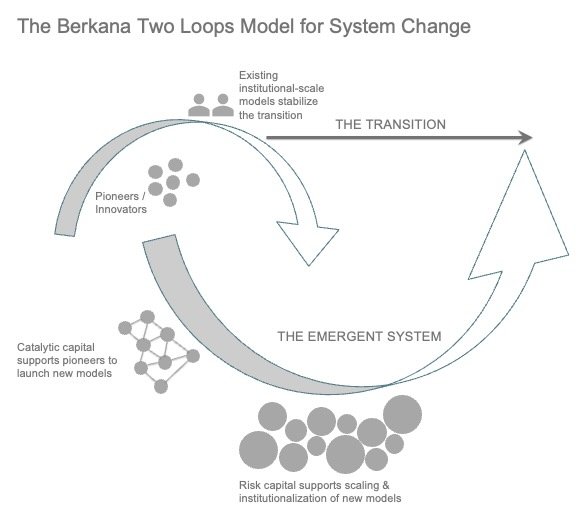
The Berkana Two Loops Model offers a framework for building a new economic system while we live in this one. A total portfolio approach can support the transition to the new system by deploying capital across the full spectrum of risk and return into each stage of the two loops evolution.
The following section describes how a systems change approach leads to a specific portfolio allocation strategy.
The systems change portfolio
The framework illustrated above creates a map for investing for systems change:
Find the stabilizers: Existing sectors and structures already deliver clear positive impact for climate and biodiversity alongside market-rate risk & returns and should comprise the market-rate portion of a systems change portfolio.
Sector examples: institutional-scale sustainable timberland and regenerative agriculture; renewable energy; affordable housing
Structure examples: B-corps; community development financial institutions (CDFIs); employee-owned corporations
Catalyze the pioneers: Innovators are developing new models and structures that bridge to the new equitable and sustainable economic system. These pioneers carry mispriced risk that can be supported by catalytic capital.
Sector examples: Alternative materials; community energy production; urban community agriculture; smallholder crop insurance
Structure examples: Catalytic first-loss debt; convertible grants; community co-ops
Incubate the innovators: Philanthropic capital can support the development of additional new models, enabling policies and intermediaries.
Examples: NatureVest, Global Innovation Lab for Climate Finance
Advocate for the transition: Publicly advocate for and describe the future we seek to build; actively work to dismantle the sectors and business models that are creating systemic risk
Portfolio construction process
Identify key systemic risks to be addressed
Build investment strategies around key risks
Establish investment goals
Develop time-bound plan to shift capital to the new strategy
Monitor and adaptively manage portfolio
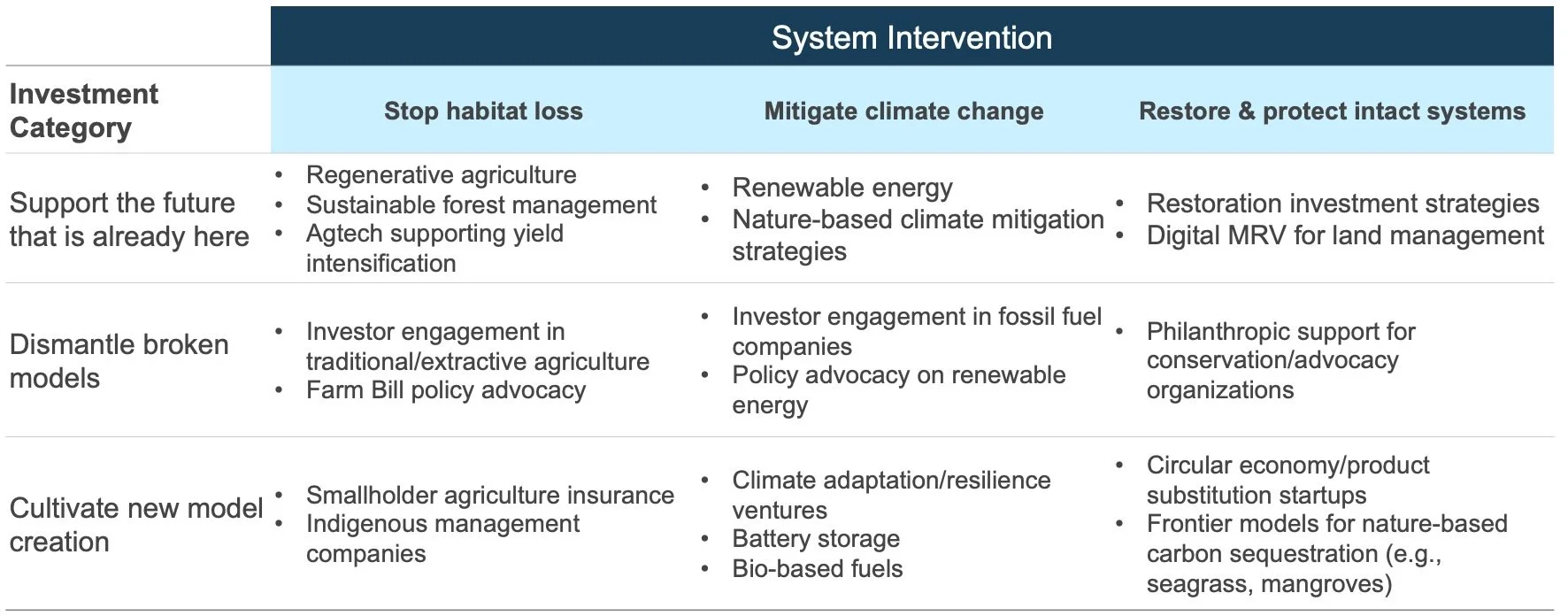
Sample portfolio for biodiversity & resilience
Map key system threats and potential interventions
Identify investable strategies to address threats and support interventions
Build the portfolio across a chosen allocation strategy for risk / return / impact
Become a systems change investor
Two Loops Advisory helps you apply this framework to your individual values, geographic focus, and portfolio.